Why your traffic is up but revenue is stuck
You finally got the clicks. The dashboard looks healthier. Yet the phone is quiet, and the inbox is strangely empty. That gap feels frustrating because traffic should mean opportunity, but too often it only means noise. The hard part is not getting seen. The hard part is turning attention into action.
The hidden leak between organic visits and actual conversions
Most businesses find this confusing because organic traffic feels like proof of progress. It is not always proof of buyer intent. A blog post can attract thousands of readers and still miss the people ready to inquire, book, or buy. That is why search engine optimization must work with conversion rate optimization, not beside it.
Here is the part most people miss: search intent matters more than volume. A page that ranks for broad terms may bring curious visitors, while a page built around a problem-specific query attracts buyers. On projects we have finished this year, the best-performing pages usually matched the searcher’s next step, not just the keyword. A coffee shop owner in Austin, Texas saw this clearly when informational traffic outran local purchase intent. Once the content aligned with location-based and service-based queries, the quality of inquiries improved quickly.
If your traffic is up but revenue is stuck, look at the page promise. Does the headline match the query? Does the form feel easy? Does the page answer the one question your target audience is asking right now? If not, the leak is probably there.
When email lists outperform paid clicks on cost per lead
Paid media can work, but it gets expensive when the offer is weak or the page is vague. An email list changes the math because you can re-engage people without paying for every click. That is why an email marketing strategy often outperforms cold acquisition on cost per lead over time. The list becomes an owned channel, not rented attention.
A retail brand in Chicago, Illinois once came to us after steady ad spend produced shallow leads. The ads were getting traffic, but the offer asked too much too soon. We tightened the landing page, then moved hesitant visitors into a simple nurture sequence. The result was not magic. It was discipline. The email follow-up gave people time to trust the brand.
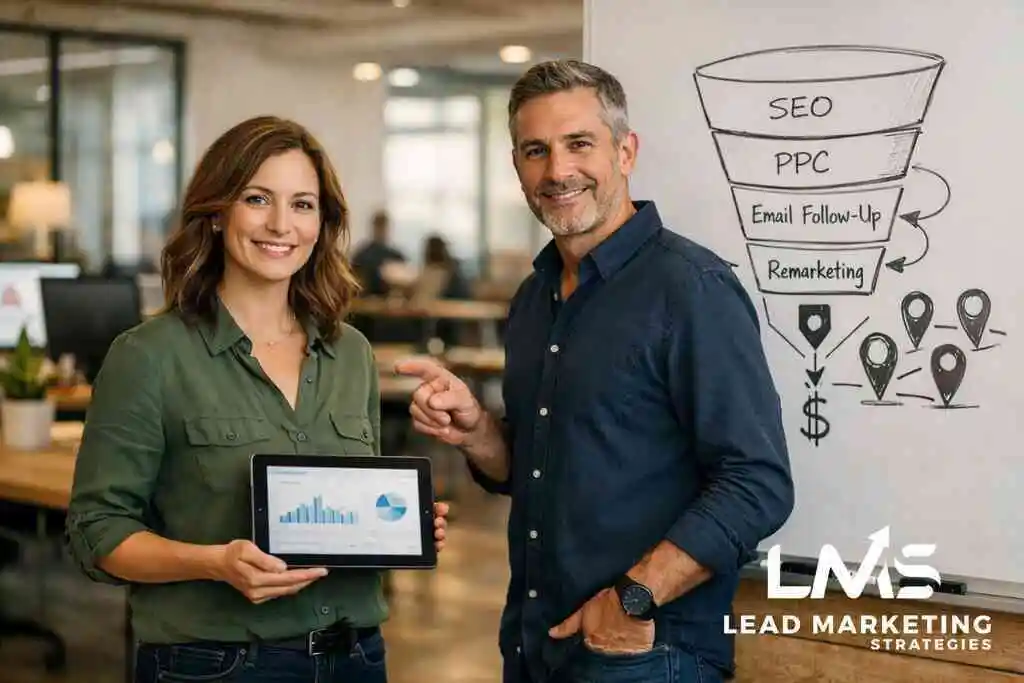
This is where marketing ROI becomes clearer. SEO brings the right people in. Email keeps the relationship alive. Paid clicks may start the conversation, but email often finishes it.
What marketing analytics should reveal before you spend another dollar
Good marketing analytics should answer three plain questions. Which pages attract buyers? Which channels create assisted conversions? Which messages move people closer to contact, signup, or checkout? If you cannot answer those, spending more only magnifies the confusion.
Before you buy another click, open Google Analytics and check behavior by landing page, source, and event flow. Look for pages with high entrances and low engagement. Then review campaign paths in Google Ads and compare them with assisted conversions. HubSpot’s State of Marketing reporting has consistently emphasized measurement and channel alignment, and that still holds up here. The lesson is simple: if you cannot trace the path, you cannot improve the path.
Here is a simple filter you can use this week:
- High traffic, low conversions: fix the offer.
- Low traffic, high conversions: expand the topic.
- Paid clicks, weak follow-up: improve email sequencing.
- Organic traffic, weak engagement: tighten intent and page structure.
Where SEO and email stop competing and start compounding
SEO and email often get treated like separate jobs. They are not. They work best when the same audience data shapes both channels, because search behavior and inbox behavior are part of one journey. That is where marketing strategy starts to feel less like guesswork and more like a system.
How keyword research and buyer persona data shape better audience segmentation
Good keyword research does more than fill a content calendar. It shows you what people fear, want, compare, and delay. Pair that with buyer persona data, and your audience segmentation becomes sharper. You stop speaking to everyone, and you start speaking to people with specific intent.
Think about the difference between a startup founder searching “how to do SEO” and a SaaS marketer searching “lead generation with SEO and email marketing.” The first needs education. The second needs a working plan. That difference should change your email segments, your subject lines, and your offers. It should also change what you say on the page.
A small business in Denver, Colorado used this idea to separate first-time visitors from repeat readers. Instead of one broad email path, they built three paths tied to intent. One focused on education, one on case-study style proof, and one on direct consultation requests. The messaging felt more personal because it was more precise.
Why on-page SEO and landing page design have to agree on the same promise
A strong page starts with on-page SEO and ends with trust. If the title promises one thing and the landing page delivers another, people leave. That is why landing page optimization must support the exact promise your search snippet makes. Search engines reward relevance, and visitors reward clarity.
Here is the practical test. Read the headline, then read the first form field or call to action. Do they match? Is the offer clear in one glance? Is the page mobile-friendly, fast, and easy to scan? If not, your page is creating friction before the conversation even starts.
In 2026 specifically, we are seeing more pages fail on speed and UX than on copy. Page speed, mobile optimization, and user experience now shape the click after the click. That matters even more for service businesses in places like Orlando, Florida, where mobile search often happens between errands, not at a desk. If the page loads slowly, the buyer disappears.
The role of backlinks, content marketing, and brand awareness in bringing qualified leads home
Backlink building still matters, but only when it supports useful content. A handful of good links to a weak page will not rescue it. Strong content marketing creates something worth citing, and backlinks help that content earn visibility. Then brand awareness makes the click feel safer.
This is where off-page SEO and brand building meet. Backlinks signal authority. Content teaches. Brand awareness reduces hesitation. Together, they improve the odds that a searcher will remember you later, even if they do not convert immediately. That is especially useful in B2B marketing, ecommerce marketing, and marketing for entrepreneurs who need longer consideration cycles.
A local business in Long Island once published a helpful guide that answered customer questions better than competitors did. The article did not only pull in traffic. It also earned links from related sites and became a reference point for sales conversations. That is the real value of content: it works before and after the click.
How email marketing strategy turns one visit into a longer customer journey
Your customer journey should not end when someone leaves your site. Email keeps the relationship open. It lets you educate, reassure, and invite action without demanding it immediately. That is why a smart email marketing strategy often lifts marketing ROI more efficiently than starting another ad campaign.
Think in sequences, not blasts. A welcome email can introduce your brand. A second email can answer objections. A third can show a useful example or a short story. Then a fourth can invite the next action. That approach supports inbound marketing, remarketing, and omnichannel marketing without sounding pushy.
One legal marketing firm in Boston, Massachusetts used this rhythm to reduce confusion after organic visitors downloaded a checklist. The follow-up emails were short, direct, and tied to specific questions. That made the next step feel obvious instead of forced. When email does its job well, it feels like service.
The system that turns search intent into sales without wasting budget
Once SEO and email begin working together, the real job is building a repeatable system. You want a process that captures intent, tests friction, and moves people through the funnel without wasting budget. That means lifecycle marketing, measurement, and a few disciplined tools working in sync.
Building lifecycle marketing around landing pages, A/B testing, and conversion tracking
Lifecycle marketing starts when you map content to intent. A first-touch visitor needs a different page than someone comparing providers. That is why landing page optimization and A/B testing belong together. You test the headline, the form length, the call to action, and even the proof points. Conversion tracking should tell you what happened after the click. Did the visitor scroll? Did they watch the video? Did they open the pricing section? Did they start the form and stop halfway? These signals matter because they show where the funnel leaks. Without them, you are guessing. 
If you manage a service business in Phoenix, Arizona, this becomes especially important during mobile-heavy traffic spikes. People scan quickly, compare quickly, and leave quickly. A simple page with one promise and one action often beats a cluttered page with five options.
Using marketing automation, CRM integration, and personalized email campaigns to move prospects faster
Marketing automation is not about sending more emails. It is about sending the right email at the right time. CRM integration helps you store behavior, source, and stage data in one place, so your follow-up feels timely instead of random. Personalized email campaigns then use that data to move prospects faster.
Personalization does not mean writing a person’s first name six times. It means matching content to behavior. If someone read three SEO articles, send them a sequence about search engine optimization and lead generation. If they clicked a service page, send a case-style explanation. If they abandoned a form, send a shorter reminder with less friction. That is behavioral targeting with purpose.
Here is a simple comparison that helps teams stay focused:
ChannelBest useCommon weaknessBest fixSEOCapture search intentSlow feedback loopImprove content and internal linkingEmailNurture and re-engageWeak deliverabilityTighten segmentation and subject linesPPCFast testing and reachRising costsNarrow targeting and improve pagesA SaaS startup in Raleigh, North Carolina used this model to route leads by interest level. High-intent visitors got a direct demo sequence. Lower-intent readers got a nurture series. The team stopped treating every click the same, and the follow-up became cleaner.
How to measure marketing ROI with Google Analytics, Google Ads attribution, and campaign KPIs
To measure marketing ROI, start with the outcome that matters most. Then connect that outcome to the channel, page, and message that influenced it. Google Analytics and Google Ads attribution can show you more than traffic. They can show assisted paths, conversion quality, and repeat engagement.
Track campaign KPIs that match business goals. Common ones include:
- Conversion rate
- Cost per lead
- Lead-to-sale rate
- Email click-through rate
- Inbox placement
- Organic traffic growth
- Assisted conversions
Do not rely on one number. A campaign can look cheap and still produce poor leads. Another campaign can cost more and create better customers. Marketing data analysis should help you see the whole path, not just the first click. That is where Google Ads, Google Analytics, CRM data, and email reporting need to talk to each other.
What small business marketing teams in all 50 states should optimize next for sustainable growth
Small business marketing teams across all 50 states usually do not need more tactics. They need cleaner priorities. Start with the pages that already attract search interest, then strengthen the follow-up. Improve page speed, mobile optimization, and UX design first, because those changes help everywhere. Then refine email segmentation and offers.
If you are running marketing tips for small business USA campaigns, keep the plan simple:
- Review your top organic landing pages.
- Match each page to one buyer persona.
- Build one nurture sequence for each persona.
- Test one offer change at a time.
- Review Google Analytics and CRM data every week.
That process works for a lawyer in Miami, a nonprofit in Minneapolis, or a restaurant group in San Jose. The market changes, but the logic does not. Good SEO brings in the right traffic. Good email turns that traffic into a longer conversation. If you want help tightening both sides, the team at Marketing Tip can help you build a cleaner strategy without the wasted spend.
How does SEO improve marketing ROI?
SEO improves marketing ROI by bringing in people who are already looking for a solution. That lowers wasted spend and raises the chance of conversion. It also compounds over time because useful pages can keep working after publication. The key is to align keywords, page intent, and conversion goals. If those three match, SEO becomes a dependable source of qualified traffic.
Why is email marketing still important for ROI?
Email marketing still matters because it lets you follow up without paying for every touch. It is especially useful after someone reads content, downloads a guide, or abandons a form. A strong email sequence can educate, reassure, and invite action over time. That makes it one of the most efficient channels for lead nurturing. It works best when segmentation and timing are specific.
What metrics should I track for SEO and email together?
Track organic traffic, conversion rate, assisted conversions, email open rate, click-through rate, and lead-to-sale rate. Also review bounce behavior, scroll depth, and form completion. These metrics show how search and email support each other across the customer journey. Google Analytics and your CRM should tell the same story where possible. If they do not, fix the tracking before you change the strategy.
Should I use PPC with SEO and email marketing?
Yes, if PPC serves a clear role. Paid search can test offers quickly and fill gaps while SEO grows. It also gives you more data on which messages convert. Still, PPC should not replace SEO or email. The strongest systems use PPC for speed, SEO for durable traffic, and email for nurturing.
How often should small businesses update their SEO and email strategy?
Review both every month, and audit the deeper structure every quarter. Search behavior changes, inbox habits shift, and offers can grow stale. Regular review helps you catch weak pages, poor segmentation, and low-performing campaigns early. You do not need to rebuild everything. You just need steady adjustments and honest measurement.
What is the simplest way to start improving marketing ROI today?
Pick one high-traffic page and one email sequence. Then make them support the same offer, the same promise, and the same next step. Check the page on mobile, tighten the copy, and add one clear call to action. After that, review your tracking in Google Analytics and your CRM. You do not have to figure this out alone, and you do not have to solve it all today. Start with one page, one email flow, and one small improvement you can ship now.
Frequently Asked Questions
Question: How does SEO improve marketing ROI when paired with email marketing strategy?
Answer: SEO improves marketing ROI by attracting people who are actively searching for answers, products, or services related to your business. When search engine optimization is aligned with landing page design, conversion rate optimization, and the right email marketing strategy, you can turn more of that qualified traffic into leads and customers. SEO brings the right audience in through keyword research, on-page SEO, and content marketing, while email marketing keeps the conversation going through nurture sequences, personalized email campaigns, and audience segmentation. That combination helps small business marketing and startup marketing teams build a stronger digital marketing ROI over time without relying only on paid traffic. For businesses across all 50 US states, the key is to match search intent, buyer persona, and customer journey so the page promise and the follow-up email feel consistent and relevant.
Question: What should I track in Google Analytics and CRM data to measure marketing ROI more accurately?
Answer: To measure marketing ROI more accurately, track the metrics that show how people move from first visit to conversion. Start with organic traffic growth, conversion tracking, assisted conversions, lead generation, click-through rate, and lead-to-sale rate. Then compare those numbers with email open rate, inbox placement, subject line optimization performance, and campaign attribution inside your CRM. Google Analytics is especially useful for seeing which landing page optimization efforts and which content marketing pages attract the most engaged visitors. If the data from your website, Google Ads, and email marketing platform does not tell a consistent story, that is a sign to review your tracking setup before changing the strategy. Marketing analytics works best when it connects search behavior, user experience, and customer journey data in one place.
Question: What makes the blog post How to Improve Marketing ROI with SEO and Email 2026 useful for small business marketing teams?
Answer: The blog post How to Improve Marketing ROI with SEO and Email 2026 is useful because it explains how SEO and email marketing strategy work together instead of competing for attention. It gives small business marketing teams a practical way to improve marketing ROI by focusing on search intent optimization, landing page design, A/B testing, and email segmentation. That approach helps businesses use fewer scattered tactics and more connected digital marketing systems. It is also helpful for marketing for entrepreneurs, marketing for local business, and marketing tips for small business USA because it keeps the advice practical, supportive, and relevant across all 50 states. Rather than promising quick wins, it focuses on durable improvements like better audience segmentation, stronger brand awareness, and cleaner conversion tracking.
Question: How can keyword research and buyer persona data improve audience segmentation and email deliverability?
Answer: Keyword research shows what your target audience is searching for, while buyer persona data shows who they are and what they need next. When you combine those two inputs, your audience segmentation becomes much more precise. That means you can send personalized email campaigns that match the customer journey instead of sending one generic message to everyone. Better segmentation often leads to stronger engagement, which can support email deliverability because recipients are more likely to open, click, and interact with relevant content. This also helps your content calendar, inbound marketing, and remarketing efforts work together more smoothly. Whether you are focused on B2B marketing, ecommerce marketing, or marketing for nonprofits, the principle is the same: use intent data to create more useful messages and reduce friction.
Question: Should businesses use PPC, SEO, and email marketing together for better digital marketing ROI?
Answer: Yes, businesses often get the best results when PPC, SEO, and email marketing support one another. PPC through Google Ads or other pay-per-click campaigns can help test offers quickly, while SEO builds long-term visibility through search engine optimization, backlinks, on-page SEO, and off-page SEO. Email marketing then helps move prospects through the marketing funnel with nurture sequences, abandoned cart email follow-up, and lifecycle marketing. This combined approach is useful for lead generation because each channel plays a different role: PPC drives speed, SEO drives durable traffic, and email drives relationship-building. For brands looking to improve digital marketing ROI, the goal is not to choose only one channel, but to connect them through CRM integration, conversion tracking, and clear marketing KPIs. That creates a more sustainable system for growth, especially when page speed, mobile optimization, and user experience are also strong.